Chaco and the Yucatán: two skies, one Sun
Fifteen degrees of latitude apart, two peoples solved the same problem: how to turn the moving Sun into a calendar. Here is what changes, and what stays the same.
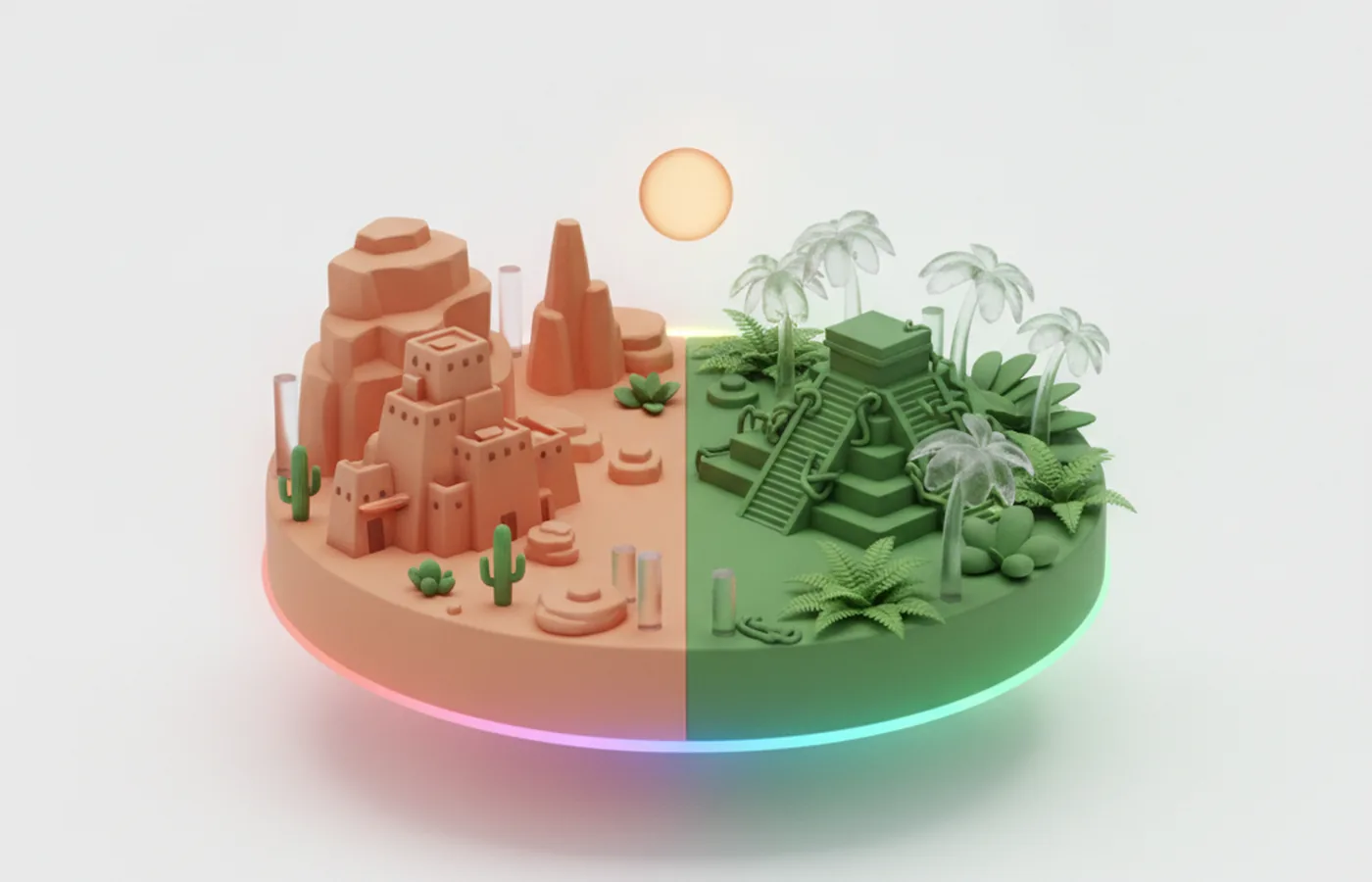
Chaco Canyon
- Site to start
- Pueblo Bonito
- Key event
- June solstice sunrise at 60.5°
- Best viewer stop
- Fajada Butte
Yucatán
- Site to start
- Chichén Itzá
- Key event
- Equinox serpent at 90.0° sunrise
- Best viewer stop
- Dzibilchaltún
| Chaco Canyon | Northern Yucatán | |
|---|---|---|
| Latitude | 36.06° N | 20.7° N |
| Landscape | High desert canyon, 1,900 m | Flat limestone plain, near sea level |
| Main period | c. 850–1150 CE | Classic to Postclassic, c. 600–1450 CE |
| Sunrise swing | ≈59° between solstices | ≈50° between solstices |
| Zenith Sun | Never: Chaco lies north of the tropic | Twice a year, late May and mid-July |
| Signature light | Sun Dagger on Fajada Butte | Equinox serpent on El Castillo |
| Calendar record | Horizon and architecture, no writing | Haab’, Tzolk’in, Long Count, codices |
| Living heirs | Pueblo peoples, e.g. Hopi and Zuni | Maya peoples of Mexico, Guatemala, Belize |
Why latitude changes everything
The further you are from the equator, the wider the Sun’s rising point swings along the horizon through the year. At Chaco it travels about 59 degrees between the solstices, so a horizon calendar there has generous spacing between dates. In the northern Yucatán the swing is narrower, about 50 degrees, and the Sun climbs much higher at noon.
Only the Yucatán sits inside the tropics. That gives Maya sky watchers an event Chaco never sees: the zenith passage, when the Sun stands straight overhead and upright posts cast no shadow at noon.
Same problem, different tools
Chacoans encoded the calendar in landscape and architecture: walls along the cardinal lines, kivas with careful axes and the light-and-shadow Sun Dagger. The Maya built alignments too, but also wrote: they kept day counts in stone inscriptions and folding-screen books such as the Dresden Codex.
Both cultures read the year from one sunrise. The difference is what they did with the answer.
Where to go next
Try the same date in both viewers. Put the slider on the June solstice and compare the sunrise azimuth: 60.5° at Chaco, 64.8° at Chichén Itzá. Then read the two field guides side by side.
See the sky the way they did
Open a viewer, pick a date and watch the sunrise point move along a real horizon. Then download the guides and take them outside.