El Castillo's Equinox Serpent: How the Shadow Actually Works
Each spring and autumn, crowds gather at Chichén Itzá to watch light ripple down a stair rail. The effect has a clear geometric cause, and a more open question about intent.
Key takeaways
- The serpent forms when the stepped northwest corner shades the north stair's western rail.
- It appears in the late afternoon for several days around each equinox, not on one day only.
- Scholars agree on the geometry but still debate how deliberately it was designed.
What exactly appears on the staircase?
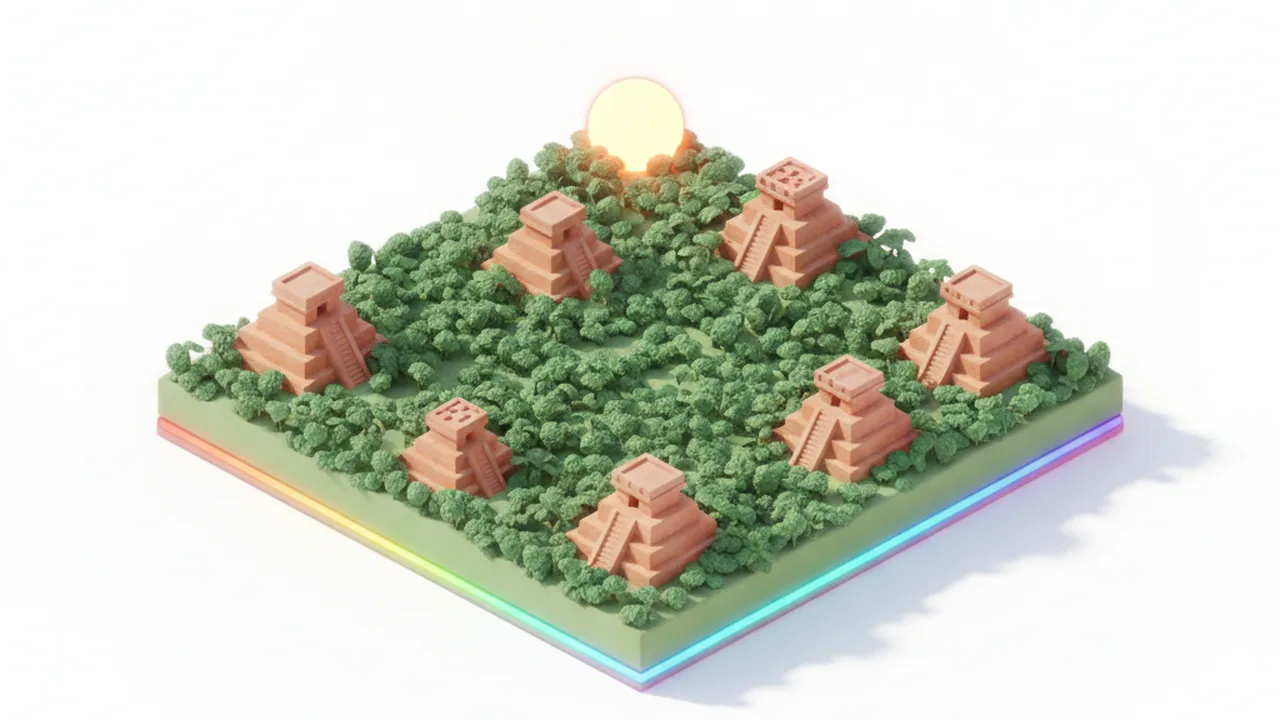
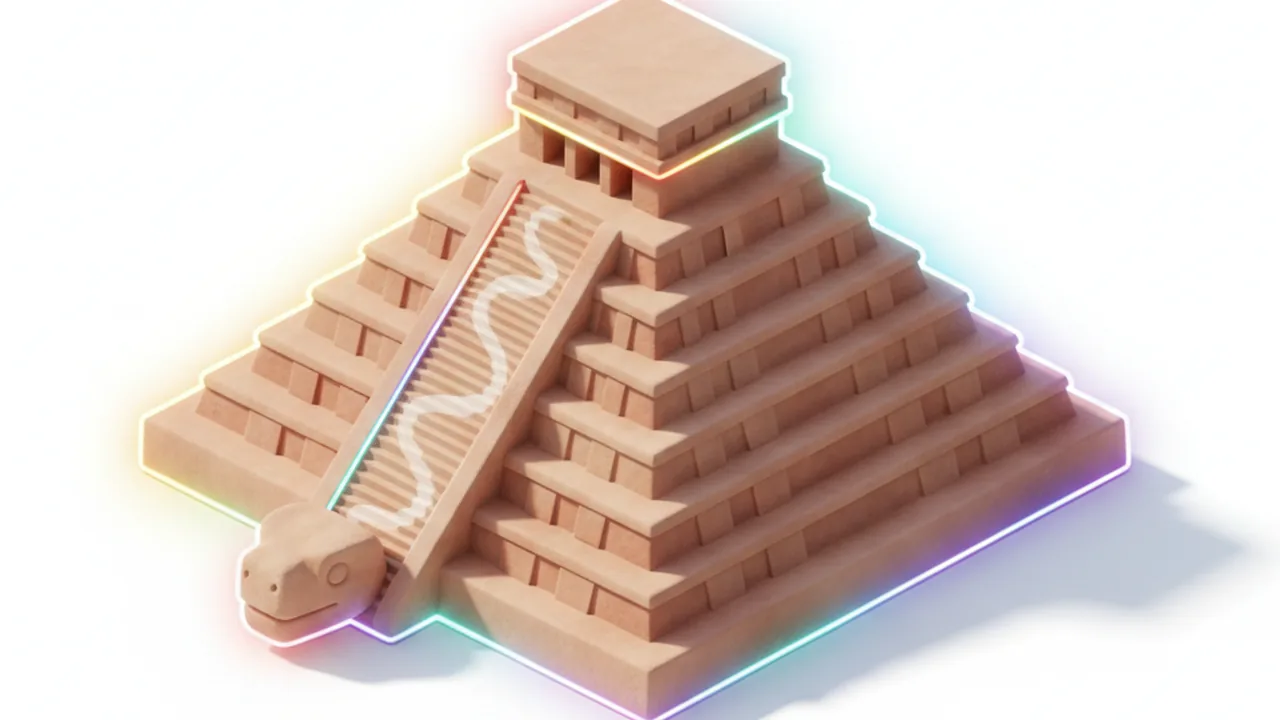
El Castillo, also called the Temple of Kukulcán, is the four-sided stepped pyramid at the centre of Chichén Itzá in Yucatán. Each side has a central stairway. At the foot of the north stairway, two large carved serpent heads rest on the ground at the base of its side rails, or balustrades.
In the late afternoon, in the days around the March and September equinoxes, the low western Sun lights the outer face of the north stairway's western balustrade. The pyramid's own stepped edge throws shadow across that face, leaving a row of bright triangles, often counted as seven. The triangles run down the rail and meet the stone serpent head at the bottom. To many viewers the result looks like a body of light joined to the carved head, a serpent descending the pyramid.
Why does the geometry produce triangles?
El Castillo rises in nine stacked terraces, each a little smaller than the one below. Seen from the side, the northwest corner of the pyramid forms a staircase-shaped edge. When sunlight strikes from the west at a low angle, each terrace corner casts its own shadow onto the balustrade face beside it.
Because the terraces step back regularly, their shadows are regular too. Each one cuts a sloping edge across the rail, and between them the sunlit parts form triangles. As the Sun sinks, the pattern slides along the rail and the triangles change shape. The effect depends on three things working together: the building's orientation, the shape of the terraces and the Sun's position low in the western sky.
Why around the equinox, and only then?
At the equinoxes the Sun rises close to due east and sets close to due west. The pyramid's sides are turned somewhat away from the cardinal directions, and with that orientation the late-afternoon Sun near the equinox strikes the north stairway's balustrade at the right angle to draw the full row of triangles.
The Sun's setting position changes only gradually from day to day, so the pattern does not switch on and off on a single date. It is visible for several days before and after each equinox, slightly changed each day. The exact equinox is not the only good day to go, and in rainy weather a clear afternoon a few days away may be better. Our Yucatán sky viewer lets you compare sunset positions across those days.
| Feature | Detail | Role in the effect |
|---|---|---|
| Terraces | Nine stepped levels | Their corners cast the regular shadows |
| Stairways | Four, one on each side | The north stair's western balustrade receives the light |
| Steps | 91 per stair by the usual count, 365 with the top platform | A calendar number often linked to the solar year |
| Serpent heads | At the base of the north stair | Complete the image of the descending serpent |
| Inner structure | An earlier pyramid inside | Shows the site was rebuilt over time |
The pyramid we see today was not built in one step. Excavations in the twentieth century found an earlier pyramid inside, with its own temple at the top. Later work has suggested further, older phases beneath. Each rebuilding was a chance to adjust the plan, which is one reason researchers are careful about assigning a single purpose to the final form.
Was the serpent designed on purpose?
This is where honest accounts slow down. The geometry is clear; intent is harder to show. Supporters of a deliberate design point to the serpent heads placed exactly where the light ends, the importance of the feathered serpent at Chichén Itzá, and the calendar-like step count. Together these make a strong case that the builders at least knew about the effect and welcomed it.
Other researchers urge caution. The pattern appears over a span of days, not at a precise moment. Some argue that the pyramid's orientation fits other solar dates better, possibly tied to the agricultural year, and that the equinox effect may have been a pleasing side result. There is also no surviving Maya text that describes the event. A fair conclusion is that the effect is real, the serpent imagery is deliberate, and the exact intention behind the timing remains debated.
The geometry is settled; the intention is still a conversation.
Who is Kukulcán?
Kukulcán is the Yucatec Maya name for the feathered serpent, a figure known in central Mexico as Quetzalcoatl. Feathered serpent imagery appears widely at Chichén Itzá, on columns, balustrades and carved panels. It links earth and sky, and in later traditions it is connected with wind, rain and renewal. Maya communities in Yucatán today still gather at the site around the equinox, alongside visitors from around the world, and the event carries meaning for many of them.
How does El Castillo fit with other Yucatán solar sites?
El Castillo is one part of a wider pattern of sky-aware building in the region. At Dzibilchaltún, near Mérida, the equinox Sun rises framed in the doorway of the Temple of the Seven Dolls. At Chichén Itzá itself, the round tower known as El Caracol has windows long associated with observations of Venus. At Uxmal, the Governor's Palace is oriented toward a far rising point of Venus on the horizon. Because Yucatán lies inside the tropics, the Sun's zenith passage was a further event to watch.
For a tour of those places, read Maya solar observatories of the Yucatán. For the wider design logic, see how the Maya used the Sun to design their cities.
Frequently asked questions
On which days can you see the serpent at El Castillo?
In the late afternoon for several days around the March and September equinoxes. Clear weather matters more than the exact date.
Does El Castillo really have 365 steps?
By the usual count, each of the four stairways has 91 steps, which with the top platform gives 365. The count is widely cited and often linked to the solar year.
Did the Maya design the shadow deliberately?
The serpent heads and imagery are clearly deliberate, and the builders likely knew about the effect. Whether the equinox timing was the main design goal is still debated.