Native American Solar Practices: Watching the Sun Across a Continent
From Pueblo villages to the Great Plains and the Mississippi valley, the Sun has organised time, work and ceremony. Many of these practices are not history. They continue today.
Key takeaways
- Many Pueblo communities keep a sun watcher who reads sunrise against horizon landmarks.
- Plains and Mississippian sites show solar interest too, though some alignments are still debated.
- Much of this knowledge is living and private; respectful study stays with what communities share.
What do we mean by Native American solar practices?
North America holds hundreds of Native nations, each with its own language, history and relationship with the sky. There is no single Native American view of the Sun, and it would be wrong to present one. What many of these traditions do share is a practical habit: watching where and when the Sun rises and sets, and using that knowledge to time farming, hunting, travel and ceremony.
This article looks at a few well-documented examples. It stays with what has been published openly or shared by communities themselves. Many details of ceremony are private, and we leave them that way.
How does a Pueblo sun watcher keep the calendar?
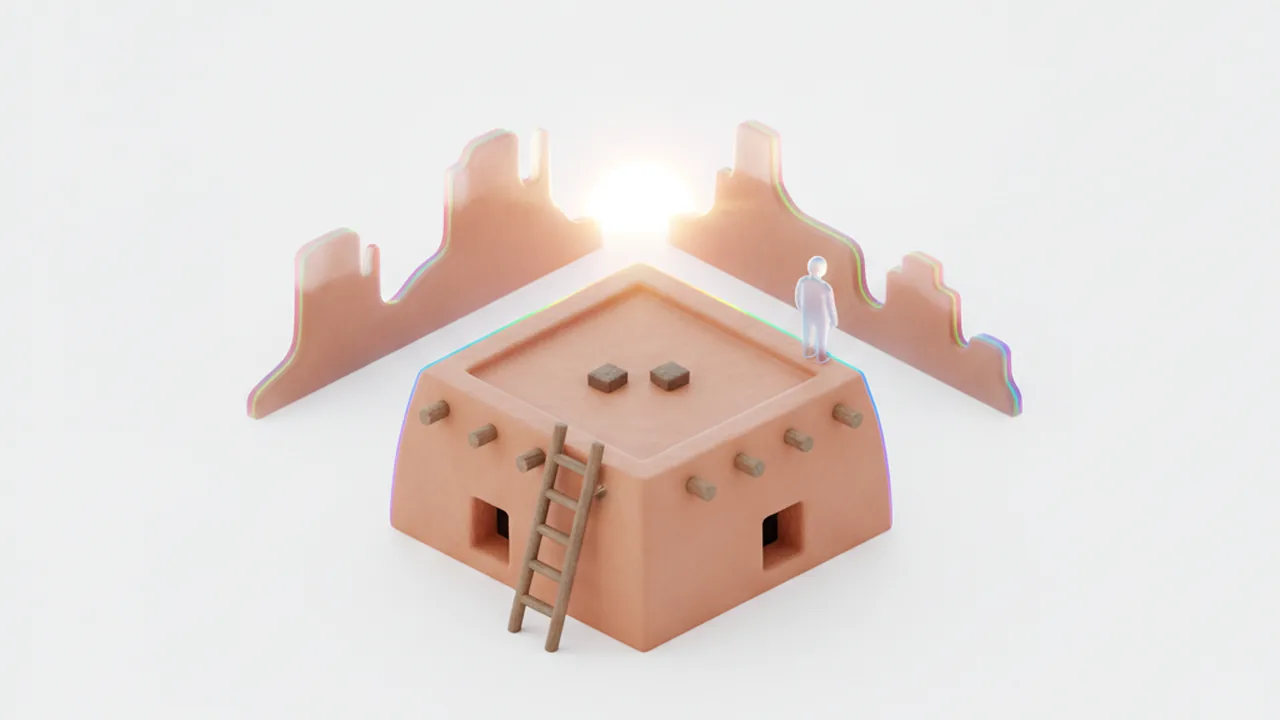
Among the Hopi, Zuni and other Pueblo peoples of the Southwest, a designated person has traditionally watched the sunrise or sunset from a fixed place. Over the year, the Sun's rising point moves along the horizon. It travels north toward the summer solstice, pauses, turns back south toward the winter solstice, and pauses again.
The sun watcher knows which notch, peak or ridge the Sun reaches at each important time of year. When the Sun arrives at a certain landmark, the watcher can announce that a ceremony or a planting period is near. Because the movement slows almost to a stop at the solstices, careful observers watch for several days to be sure of the turning point.
This method needs no instruments. It needs a fixed viewing spot, a well-known horizon and many years of experience. It is also accurate. Horizon calendars of this kind can mark a date within a day or two, which is enough to coordinate a whole village.
A horizon calendar is a skyline that a community has learned to read like a page.
What does Chaco Canyon add to the story?
Chaco Canyon in New Mexico was a major centre of Ancestral Puebloan life roughly between the 800s and the 1100s CE. Its builders left several features that researchers link to the Sun. The best known is the Sun Dagger on Fajada Butte, documented by artist Anna Sofaer in 1977. Daggers of light fall across spiral petroglyphs behind leaning stone slabs at key times of the year. Several great houses, including Pueblo Bonito, also show alignments to cardinal directions and solar events.
Pueblo people today regard Chaco as an ancestral place. That connection matters. The modern practice of the sun watcher helps archaeologists understand what the Chacoan features may have been for, while the ancient sites show how deep the tradition runs. You can read more in our article on Chaco Canyon's sun alignments, or explore the horizon yourself in the interactive Chaco viewer.
Did other regions track the Sun as well?
Yes, though the evidence varies in strength. Researchers have proposed solar alignments at many sites, and not all of the claims hold up equally well.
| Region | Example | Proposed solar link | Status of the evidence |
|---|---|---|---|
| Southwest | Pueblo sun watchers | Horizon calendar for ceremony and planting | Documented in living communities |
| Southwest | Fajada Butte, Chaco | Light markers at solstices and equinoxes | Widely accepted, details discussed |
| Mississippi valley | Cahokia post circles | Sunrise at solstices and equinoxes | Plausible, still debated |
| Northern Plains | Bighorn Medicine Wheel | Solstice sunrise and some stars | Debated; uses may have varied |
At Cahokia, near today's St. Louis, archaeologists found rings of large post pits, often called Woodhenge. Some researchers argue that certain posts marked solstice and equinox sunrises seen from a central point. On the northern Plains, stone medicine wheels such as the one in the Bighorn Mountains of Wyoming have been studied for possible solar alignments. In both cases the solar reading is one interpretation among several, and Native communities hold their own understandings of these places.
Why does the Sun matter so much in these traditions?
For farming peoples in a dry land, timing is survival. Plant maize too early and a late frost kills it. Plant too late and the crop does not ripen before autumn. A reliable calendar was a real tool, not a decoration.
The Sun also carries meaning beyond the practical. In many Native traditions it is addressed with respect, as a relative or a life-giving presence, and morning prayers to the Sun are common. Ceremonies tied to the solstices mark the turning of the year and the renewal of life.
The winter solstice carries special weight in many Pueblo communities. It is the moment when the Sun stops moving south and begins its return, and the days start to lengthen again. Knowing that moment in advance allows preparations to begin on time. In this sense the sun watcher's skill supports the whole community: farmers, families and religious societies all depend on the same reading of the horizon. Plains nations hold the Sun Dance, a major ceremony whose inner details belong to the participants. Respectful writing can name such ceremonies without describing what communities keep private.
How should we study living solar traditions today?
Three principles guide this site. First, use the present tense for living communities. Pueblo nations are not a vanished culture; they continue their practices and their governance. Second, separate what is documented from what is guessed. An alignment measured on the ground is evidence; a story about what it meant needs support. Third, respect the line between shared and private knowledge. Not every question needs an answer from outside.
This approach also improves the science. Archaeoastronomers who work with tribal advisers often gain context that measurements alone cannot provide. Our guide to Indigenous knowledge systems looks at that relationship in more detail, and the free field guides offer classroom-ready material on Chaco.
The common thread across the continent is attention. People watched the same horizon for generations and built their year around what they saw. That habit of close, patient observation is one of the oldest forms of science on the continent.
Frequently asked questions
What is a Pueblo sun watcher?
A person in some Pueblo communities who traditionally observes sunrise or sunset against horizon landmarks. The observations help announce the timing of ceremonies and farming work.
Is Cahokia's Woodhenge proven to be a solar calendar?
Not conclusively. Some researchers argue certain posts marked solstice and equinox sunrises, but the interpretation is still debated.
Can visitors attend Pueblo ceremonies?
Some public dances welcome respectful visitors, while others are closed. Always check the specific community's rules, including limits on photography and recording.