How to Make a Horizon Calendar and Track the Sunrise
Pueblo sun watchers read the year from a skyline. With one fixed spot, a sketch and a weekly sighting, you can build the same kind of calendar at home, and add a camera if you like data.
Key takeaways
- A horizon calendar needs only a fixed viewing spot, a skyline with landmarks and a record of where the Sun rises each week.
- At mid-northern latitudes the sunrise point swings about 30° either side of due east over a year, fast near the equinoxes and almost not at all near the solstices.
- A fixed camera turns sightings into measurements: count pixels between the Sun and two known landmarks to get the azimuth.
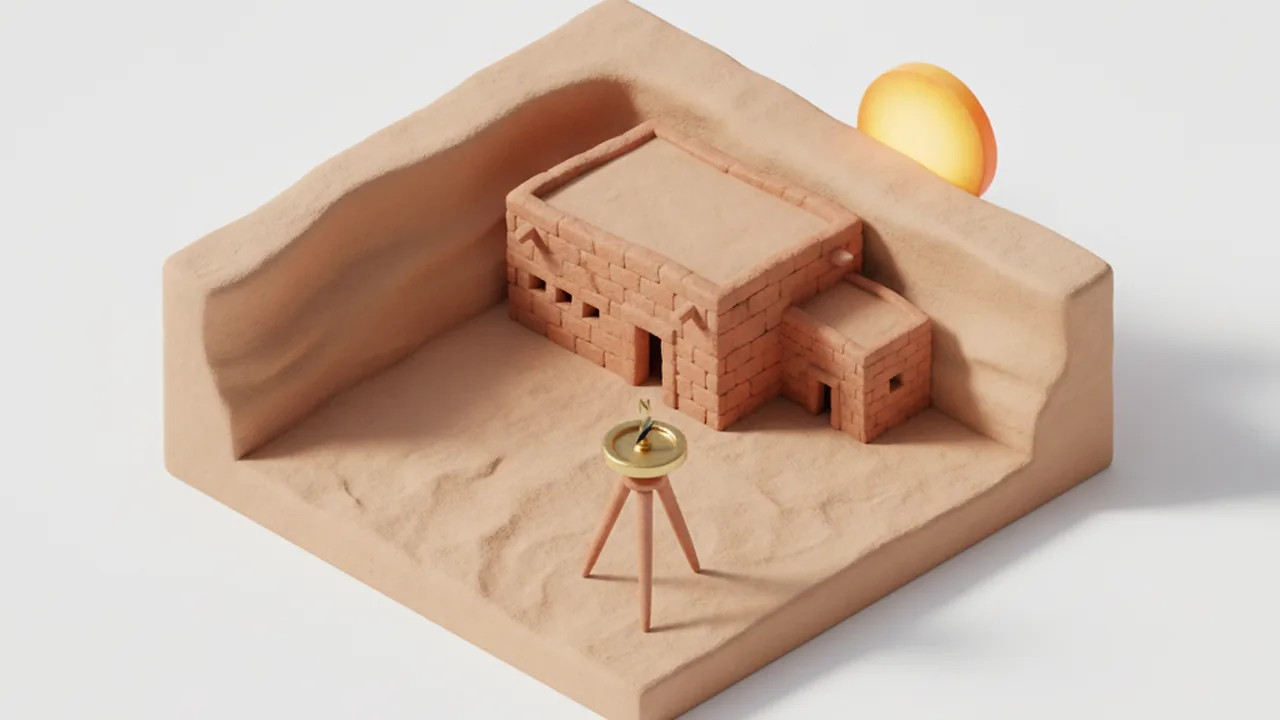
To make a horizon calendar, choose one spot you can return to, draw the eastern or western skyline as seen from it, and mark where the Sun rises or sets once a week. After a season the marks show the Sun walking along the horizon, slowing and turning back near the solstice. That is the whole method, and it is how communities without printed almanacs kept a precise year.
A notebook and pencil are enough. If you want exact dates and degrees, a cheap camera on a timer can take the same picture every dawn. Making that camera survive months outdoors, wake on its own, keep accurate time and send its frames over the network is ordinary work for teams offering internet of things services, and a hobby version fits on a windowsill.
The idea is old and still alive. Hopi and Zuni sun watchers have long followed sunrise against named points on the skyline to time ceremonies, as explained in how ancient observatories predicted solstices. This guide turns that principle into a project you can start before the December solstice.
How does a horizon calendar work?
A horizon calendar works because the sunrise point moves along the horizon through the year. Earth's axis is tilted about 23.44° to its orbit, so the Sun's declination swings north and south between the solstices, and its rising point follows.
Near the equinoxes in March and September, the Sun rises close to due east and moves quickly, by roughly the width of its own disc each day at mid-latitudes. Near the solstices it slows, stops and reverses. According to the High Altitude Observatory's guide to horizon calendars, the daily shift drops to about 10 arcminutes twenty days before a solstice and about 5 arcminutes ten days later, close to the limit the naked eye can detect.
How wide the swing is depends on latitude. The farther from the equator, the wider the arc:
| Place | Latitude | June sunrise | December sunrise | Yearly swing |
|---|---|---|---|---|
| Chichén Itzá | 20.7° N | 64.5° | 114.8° | about 50° |
| Chaco Canyon | 36.1° N | 59.8° | 118.8° | about 59° |
| A city at 45° N | 45° N | 54.8° | 123.2° | about 68° |
Azimuths in degrees from true north, flat horizon with standard refraction. Method and more latitudes in our guide on how to calculate sunrise azimuth.
What do you need to make a horizon calendar?
You need a fixed observing point, a view of the eastern or western horizon, and a way to record the Sun's position. Everything else is optional.
- A fixed spot. A doorstep, a balcony rail, a bench or a stake in the yard. Moving even a meter shifts nearby landmarks against the Sun.
- A horizon with features. Peaks, notches, trees, chimneys, towers. Distant landmarks are better than near ones because they shift less if you stand slightly off your mark.
- A record. A skyline sketch, tape on a window, a photo series or a sensor log.
- A compass or map bearing to check where true east lies, corrected for magnetic declination.
- A calendar of the season's key dates. Our sky calendar lists the coming solstices and equinoxes.
Sunset works as well as sunrise and is easier for late sleepers. The pattern is a mirror image along the western horizon.
How do you build a horizon calendar step by step?
Set the calendar up in one afternoon, then observe for at least one season. Follow these steps:
- Fix the viewing point. Mark it so you can return to the same place: a paint dot on a railing, a stone in the yard or tape on the floor by a window. For a window, always put your eye at the same height, for example with your chin on a book stack.
- Draw the skyline. Sketch the horizon from about 50° to 130° azimuth for sunrise (or 230° to 310° for sunset). Include every notch and bump, and label them with names you will remember.
- Find due east. Take a bearing with a compass corrected for magnetic declination, or use a map. Mark east on the sketch so you can see which side of it the Sun is on.
- Record the first gleam. Note the date, time and the exact point where the upper edge of the Sun first appears. Draw a small tick on the sketch, or put a dot of tape on the window where the Sun sits.
- Repeat weekly. Once a week is enough in most seasons. Within about three weeks of a solstice, look every day if you can, because the turning point is the event you are after.
- Name your markers. Once you see which landmark the Sun reaches on which date, give the important ones names, such as "two weeks before midwinter". That is the moment the sketch becomes a calendar.
How do you record sunrise with a camera or sensor?
A camera fixed in one place records sunrise more precisely than a sketch because every frame shares the same geometry. You can then measure the Sun's position in pixels instead of judging it by eye.
Set up a fixed time-lapse camera
Any camera that can sit still for months will work: an old phone on a clamp, a trail camera, or a small single-board computer with a camera module. Set it up in three steps:
- Point it at the sunrise arc, with the solstice points inside the frame.
- Lock focus and exposure so every frame matches.
- Schedule one or several frames around local sunrise time.
Mount it so it cannot rotate; a camera that slips by 1° destroys the measurement.
Convert pixels to degrees
Pick two distant landmarks in the frame and get their azimuths from a map or a careful compass reading. Divide the angle between them by the pixel distance between them to get degrees per pixel. The Sun's azimuth on any frame is then the azimuth of the nearer landmark plus its pixel offset times that scale. A wide lens distorts near the edges, so put the landmarks and the solstice points near the middle of the frame when you can.
Log first light with a light sensor
A light sensor such as a photodiode facing the horizon, read by a microcontroller every few seconds, records when light first jumps at your skyline. It gives time, not direction, but the sunrise time over a fixed skyline also traces the season and helps you check your camera's clock. The practical details decide whether a logger survives the winter:
- keep the clock synced to network time or a GPS module, because a drift of minutes blurs the curve;
- power the board from a battery with sleep between readings, or from a small solar panel;
- protect it from condensation inside a sealed box with a clear window;
- save each reading locally first, then upload, so a lost connection does not lose the morning.
What will you see over a year?
Over a year your marks form a band along the horizon with two turning points at its ends and fast motion in the middle. The pattern is predictable enough to check against a calculation:
| Period | What the sunrise point does | How often to observe |
|---|---|---|
| Weeks around the March and September equinoxes | Crosses due east at its fastest, roughly 0.5° a day at mid-latitudes | Weekly; each mark is far from the last |
| Five to three weeks before a solstice | Slows noticeably as it nears its limit | Twice a week |
| About a week either side of a solstice | Appears to rise in the same spot, then turns back | Daily, to catch the turn |
| After the solstice | Retraces the same track in the opposite direction | Weekly again |
The pause near the solstice is why watchers in the past used advance markers. Since the turning point is hard to see on the day, a landmark the Sun reaches a known number of days earlier gives warning. With a year of your own records you can pick such a marker yourself, which is the best way to understand why traditions such as the Pueblo sun-watching practices worked the way they did.
What are the most common mistakes, and how do you avoid them?
Most failed horizon calendars fail because the observer, not the Sun, moved. Watch for these problems:
- Shifting viewpoint. Standing half a meter to one side moves a nearby tree by several degrees. Use distant markers and a fixed eye position.
- Uncorrected compass. A phone compass points to magnetic north and can be pulled off by metal nearby. Check east against a map or the NOAA Solar Calculator.
- Ignoring the skyline height. A ridge raises the horizon, so the Sun appears later and slightly farther south in the morning than a flat-horizon calculation says. Your own observation already includes that effect; a calculation does not.
- Losing the solstice to weather. Two or three cloudy mornings can hide the turn. Record the days on both sides and take the midpoint of matching positions before and after.
- Changing landmarks. Trees grow, cranes come and go. Use features that will still be there next year.
If you want to see the effect before your first frost-bitten dawn, open the Chaco sky viewer, choose a date in December and watch the sunrise point creep south along the mesas.
How should you think about horizon calendars in living traditions?
Horizon calendars are not a lost technique. Among the Hopi, Zuni and other Pueblo communities, sun watching remains part of religious life, and the knowledge of which landmarks matter and why belongs to those communities. A backyard calendar teaches the astronomy; it does not reconstruct their practice.
If you visit Chaco Canyon or other ancestral places to watch a sunrise, follow park rules and closures. Fajada Butte at Chaco, for example, is closed to visitors to protect the site. Treat places still used in ceremony as private, and leave no markers of your own.
Frequently asked questions
What is a horizon calendar?
A horizon calendar is a fixed viewing spot plus a skyline whose peaks, notches and buildings act as date markers. Because the sunrise point shifts along the horizon through the year, the landmark behind which the Sun rises tells you the season.
How long does it take to make a horizon calendar?
Setting it up takes an afternoon. A useful calendar needs at least one season of weekly sightings, and a full year shows both solstice turning points and both equinox crossings.
Can I make a horizon calendar in a city?
Yes. Rooftops, chimneys, towers and gaps between buildings work as markers as long as they stay put. An east-facing window with tape marks on the glass is the simplest city version.
Why does the sunrise seem to stop near the solstice?
Near a solstice the Sun's declination changes very slowly, so the sunrise point moves only a few arcminutes a day. For about a week it appears to rise in the same spot, which is where the word solstice, the Sun standing still, comes from.
Is it safe to photograph the sunrise?
Never look at the Sun through binoculars, a telescope or an optical viewfinder. Use the camera's screen, take the frame at the first gleam when the Sun is dim and low, and do not leave a lens pointed at the high Sun for long.